Los Angeles, the city of angels.

A city built in the middle of a desert.  A city built on dreams.  A city built on great storytelling. So much has been said about Los Angeles, all one need do is watch Lynch’s MULHOLLAND DRIVE and one starts to understand.

I first moved to LA in 1993 to start Digital Domain. I dreaded the move, having lived in the San Francisco Bay Area for for almost two decades.  San Franciscans, especially those of us in media, hated LA.  Moving to LA was considered to be the great cop out.  The city by the bay had a long standing issue with its big sister 400 miles to the south.  The Giant/Dodger rivalry was just the tip of the iceberg.  San Francisco had long been the financial capital as well as the most sophisticated city in California, or so we thought.  San Francisco had a history, albeit only one that spanned about 150 years. LA seemed like its history started when Hollywood did. San Francisco had a very diverse population, not just in terms of ethnicity, but also in terms of one’s vocation.  The Bay Area was not a company town.  One could go to a party and meet people that were employed in various fields.  Los Angeles on the other hand seemed to be very segregated.  There were folks that were in the “biz”, folks that wanted to be in the “biz” and the other fifty.  San Franciscans always put LA down. Angelinos thought San Francisco quaint.

It took me awhile to get comfortable with names like Cahuenga or Tijunga, or that when driving on a freeway, when I used my turn signal to indicate that I wanted to change lanes, all the other cars would speed up, ensuring that I would stay in my lane, and miss my exit for Port Hueneme (?). I was, and to an extent, still am confused by Freeways that have names instead of numbers.  Sometimes the freeways have the same names but different numbers and sometimes the same freeway will go in all directions, north, west, east and south. WTF!!!!

But I first realized just how strange LA was when I went to my first LA movie premiere party. TRUE LIES premiered on July 15, 1994. The screening was at Mann’s Village in Westwood but it was the extravagant party afterwards that made me uncomfortable. I arrived at the location with my then wife, and was treated as the nobody that I was. I walked around the party watching all the “beautiful people” air kissing, feeling very out of place. After about an hour of this, I decided it was time to leave. As we were walking out, someone from the press saw me and tried to get my attention. Once there were cameras flashing at me, a crowd gathered. Someone mentioned I was Cameron’s partner and then I was surrounded. Being Jim’s partner never felt so good… really. One second, I was invisible, then one second later having had some connection with a famous director, I was “someone”.

Years later, after my divorce, having dated a few “wanna be” or more to the point “never was” actresses, I really got it.  One night, my date said to me that she had been out the other night at an industry event and had met the writer of CRASH. I got pretty excited because CRASH had blown me away and I had quickly become a fan of the writer/director.

“Wow, you got to meet Paul Haggis, what was he like?”, I said.

” No, I met Jim Franklin, the writer”, she protested.

“No, Lucy, the writer’s name is not Jim”, I said.

“He showed me his card… he was the writer of CRASH”, she continued.

Los Angeles, the city of lies.

I wondered, is this the way it works in this town. Fake it till you make it.

When I started DD, I needed to hire a handful of senior people that would help me build this new company. DD needed technologists, producers, visual effects supervisors, artists, finance people, lawyers , human resources and a plethora of others that would allow us to scale up to become one of the largest studios of its kind in the world. Many of these folks I had known over the years and some of them would come highly recommended from folks I had known over the years but a few would come to our attention from folks that we didn’t know.

One fellow, (who will remain nameless, though I’ll call him Richie) , came recommended from folks that I didn’t know.  I met him and his wife and while he was charming, well connected and very senior, it was his wife that won me over.  She seemed so down to earth. I offered him the position and I did so never having checked any references. He had been in the business for a very long time and seemed to know everyone. Some said he had the greatest rolodex ever.  Unfortunately he did not live in LA and so when we hired him, we had to offer him temporary housing for a short while, until he relocated to the LA area.

I guess Richie had been used to the “high life” in his previous positions because he demanded to be put up in a very toney Santa Monica hotel. I assumed that he would stay at the hotel for a week or so until he found an available rental. Richie stayed for a long time. We later found out that he had cut a deal with the management at the hotel that after DD had paid its bill, the extra amount that the hotel billed found its way into Richie’s pocket. Richie was a piece of work, he only traveled in style…. town cars, business class, five star hotels, rooms with a view. Richie was wild.  Richie didn’t know much about technology, filmmaking or for that matter, much about anything. Though Richie seemed to have “secrets” and knowledge of certain indiscretions about powerful people in the biz.  Richie would accompany me on all the speeches I would give. Richie had the uncanny ability to open doors. Richie was tan, well dressed and glib. Richie spent company money like we were, well, rich, which we weren’t.  This went on until we discovered that Richie was doing certain things that didn’t fit well within our code of ethics, and so, Richie was fired.

Well, that didn’t stop him. After all, this is LA. This fellow has gone on to several high profile gigs, now gives speeches himself (though he has borrowed a bunch of his rap from others) and has, according to some sources, said that he personally started Digital Domain.

That all being said, I guess I too have succombed to the LA syndrome as well.  In the late 1990’s, for some strange reason ( maybe because of Rich), I was considered to be a leading expert on technology. Digital was a catchword that appeared everywhere. I was actually voted to be one of the top 100 most influential persons in the digital world in 1998. Hmmm, don’t believe what you read.

It is because of that lofty position that I received an invite to write an article for Qwest Communications annual report.  Mark Dowley, a senior executive at McCann Erikson asked me to write something about the digital age for Phil Anschutz, at the time, Chairman of Qwest Communications. He made me an offer that I found difficult to refuse.  In return for said article, I would be invited to the 2001 PGA Pro Am event, The International at Castle Pines Country Club in Colorado. I was, at the time, an aspiring golfer. I fell in love with the game after reading my friend’s book, “Golf In The Kingdom”. I was, and still am, a terrible golfer, though when Dowley asked me what my handicap was, I thought if I told him the truth ( a 29), I would not be invited.  I lied and told him I was a 14.  I don’t remember what I wrote but I do remember the golf.

I flew to Denver where a car was waiting to whisk me off to Castle Pines. I checked into the lodge and was told that I would need to be downstairs bright and early, 6AM.  I don’t think I slept that night, I was so excited by the thought of playing golf on this course in this event.  Six AM came quickly.  I put on my golf attire and headed to the lobby.  I got on the bus with a lot of white middle aged guys and we drove over to Castle Pines. It was pristine. I checked in and found out that my pro was to be Mark O’Meara. We were to play best ball, that is the best shot of the foursome would be played and the other three in the foursome would drop their ball at the spot where the “best ball” lied. Then each of us would hit again, and once again, the “best ball” would be the next drop, and so on.

At check in, each amateur received a goody bag which included a great putter and a pair of Nike golf shoes.  We also met our caddy. My caddy was named Steve. Steve was about 30, stood about 6 feet tall and most probably had a single digit handicap.  Steve wore a white jump suit and emblazoned on his back was “ROSS”.  Wow.

We headed to the driving range.  There were press and spectators everywhere.  I grabbed a 7 iron and started hitting perfect 155 yard draws. I hit my nine iron like a champ. As I reached for my driver, a loud claxon sounded.

Steve said ” Okay Mr. Ross, we tee off on the 18th, it’s a shotgun round. Do you have a few sleeves of golfballs?”

“No, I assumed that the tournament provided balls”, I said.

“Well, no sir, they don’t. Why don’t you head over to the Pro Shop and buy a few sleeves, this course eats golfballs and with you as a 14… I’d buy at least two”, Steve answered.  “I’ll carry your sticks to the 18th tee… I’ll meet you up there”.

I headed to the Pro Shop. There was a line at the register. Earlier that day I was given a little gold lapel pin that indicated I was a “player”.  Little did they know.  After what seemed an eternity, I finally flashed my pin and moved to the front of the line. I paid for the balls and headed up the cart path of the 18th fairway.  I heard the PA announce the first foursome.

“On the tee from Jupiter Florida, Ernie Els”, the PA blared.

I started to run.  I zig zagged between the throngs, stumbling on occasion. I reached the 18th tee completely out of breath and tried to make my way to the tee box. A security guard stopped me, wondering who this madman was. I flashed my pin. He still didn’t believe me, but Steve spotted me and waved me in.  The security dude relented.

“On the tee from Malibu California, Scott Ross”, the PA bellowed.

Steve handed me my driver. I stepped up to the tee box, which was surrounded by bleachers filled with about 100 spectators.  I  teed up my ball, driver in hand and looked down the 18th fairway, which was lined by even more spectators. I addressed the ball. I waggled my driver, slightly touching the ball. It fell off the tee.  I teed up again. I waggled again. I touched the ball again, watching it fall off the tee. Again.

I could hear the gasps from the crowd. The laughter from some. I teed it up one more time. No waggle this time, I hit the ball and it took off. A duck hook directly into the crowd. Thank god I didn’t hurt anyone.  People starting yelling… “Way to go Ross!”, “Be the man, Ross” ….

I watched the other three tee off.  O’Meara hit it 325 yards in the center of the fairway. Clearly we weren’t going to play my ball.  I left my ball where it landed and headed down the 18th fairway, head hanging.  Steve caught up to me. I handed him my driver, he handed me a new ball.

“Mr. Ross, don’t worry, it happens to all of us, you’re a 14 handicap, you’ll do better as you calm…” Steve said.

“Steve, I’m a 14 handicap in LA, in Colorado, I’m a 29”, I said.

I’m not sure Steve understood, after all, he was from Ft. Collins.

And I guess, now…. I was from LA.


· · · ◊ ◊ ◊ · · ·

The realization that the only way to get a $150,000,000 epic, historical love story movie made was to attach one of a handful of directors or actors that the studio, even though they would rather not make the film, had to carefully consider making, lest they piss off a serious revenue generator.  I saw that first hand when Tom Cruise and Cameron Crowe wanted to remake the 1997 Spanish film ABRE LOS OJOS (OPEN YOUR EYES)… or as we know it, VANILLA SKY.

Back then the directors that could get a movie made was comprised of James Cameron, George Lucas, Steven Spielberg, Clint Eastwood, Ridley Scott, Roland Emmerich, David Fincher, Robert Zemeckis and Peter Jackson.  At least, that was my take.  I spoke to most of them, and a few more.

Several directors didn’t feel “right” for the film ( how pompous and arrogant can a VFX nerd get?), so I didn’t pursue them.  George Lucas and I were not really on good terms, considering all that happened back at LucasFilm, so I didn’t approach him. I admired Fincher a great deal and since we had known each other for twenty years or so, I personally gave him the script to read. Not sure if he was being nice …  ( he generally isn’t) but he said he liked it, yet as he said, it seemed “really really expensive”.  And then there was Cameron.  At the time, Jim and I were still partners, and while we had “disagreed” about many things, I talked to him about the project at lunch one day at Chaya Venice. He was talking about doing smaller art films in the wake of TITANIC’s incredible success. Something about a fellow with multiple personality disorders.  I, of course, was really interested in Jim’s take on my Hiroshima bomb movie.  I mean, it had all the elements for a Cameron film. A strong female lead, a repentent and reluctant male hero, a message film about world peace. A shitload of visual effects. Perfect. Right?

Cameron wasn’t biting… too bad, he would have made a great CRANES.  Unfortunately Jim and I had a major public falling out. I had to stand up for what I believed was right and unfortunately Jim didn’t see it my way.  If only one could turn back the hands of time, I would have handled it so very differently.

A few years after that lunch, I had noticed that Jim had hired some writers to do a “take” on something about Hiroshima and the bomb.  Something about the grandkids of Japanese survivors wanting revenge on the USA and getting their hands on a Nuke. Then a little later there was the news that Cameron had optioned a book called “The Last Train From Hiroshima” written by Charles Pelligrino, a frequent collaborator of Jim’s.  Recently the book has been pulled by the publishers as there where doubts about the authenticity of this “true” story.

I then had a crazy idea. Who was the director that I, given my druthers, would die to have direct CRANES?

Milos Foreman, while not a guaranteed green light director, would be able to attract world class talent that might get the film financed. Forman was old school.  He had the same manager/agent for what seemed like an eternity.  I must have spoken to this rather elderly New York gentlemen with a thick accent ( I can’t recall his name) for a year or more.  And every time we spoke, he assured me that Milos was “very interested, but very busy”. This conversation became a monthly regimen.  I would make the call, he would take the call, he would put me off.  It took me awhile to understand that people in the movie business rarely say “No”.  They usually say how much they like something, but, that it’s not right for them at this time. The Japanese have a very similar quality.  They Japanese word for yes is “Hai”, the word for no is “Hai” (said while sucking air in between their teeth).

Having run through a directors who’s who, I turned my attentions to actors that could get a movie made. CRANES is a film that is limited in attracting international stars as most of the film takes place in Japan. In fact, most of the actors are Japanese. If you hadn’t noticed, there aren’t many major Japanese movie stars that are big box office draws. Maybe that’s why MEMOIRS OF A GEISHA starred Chinese actresses! The only leading role that would attract a major movie star would be the role of Nic, our male protagonist.  Nic, is Russian by birth, though he grew up in the U.S..  Nic is supposed to be around 33 years old. When I started on this journey, back in 1998, there were a handful of actors that could play the role.  There were even fewer that could play the role and qualify as a movie star that would get the movie made. In fact, there was only one that really fit the bill.

Brad Pitt.

Getting the attention of a movie star is a lot more difficult than getting the attention of a major Hollywood director, at least for me.  Going the typical route of contacting their agent, is, for the most part, a non starter. Agents make their money by commission. Agents are mostly interested in the highest possible price they can negotiate for their client. Agents don’t want to spin their wheels, Agents want a sure thing, especially for their highest grossing client. Agents of big stars will only talk to Producers that are well financed and famous.  Agents have assistants that guard them with a vengeance.  “… and he would know you because?” “And he is expecting your call?” “I’m sorry but, he can’t speak to you now… or ever!”

I had heard through some friends, supposedly in the know, that Brad Pitt had a psychic.  And that he consulted with this Psychic on all decisions regarding projects that he might get involved with. I must say, that I’m a New Yorker and most definitely not of the “woo woo” variety, but I set up an appointment with said Psychic. A fifty something charming Persian woman, nicely coiffed and affable answered the door. She was located in the mid Wilshire district in a nondescript two bedroom with lots of tchotchkis sprinkled throughout her apartment. She asked me all kinds of questions. She pulled out a deck of Tarot Cards. She recorded the session on a cassette player. I told her all about CRANES, but I didn’t want her to know that I had come for the specific purpose of getting my script to her client. At the end of the session, I handed her $150 and as I was walking out the door, I made mention that I thought Brad Pitt would be perfect for the starring role.

She thanked me and said ” Visualize Brad calling you on the phone, and accepting your offer”.

I did… for several months, but I guess Brad never got the vibration of my visualization.

The other two movie stars that could get CRANES made, though not quite perfect for the role were Tom Cruise and George Clooney.  George had already passed because, according to his “people”,  he didn’t want to do another WWII movie after THE GOOD GERMAN. So that left Tom. I had, over the years spoken to Paula Weinstein, Cruise’s producing partner.  I rang her, I sent the script over, I never got a return call.  So, I called, a lot, and was finally told that they really liked it but they too had a Japanese film, THE LAST SAMURAI.

Visual Effects production was looking very appealing.

I started to retrench.  Maybe the screenplay wasn’t as good as I thought.  Maybe, creative people of the caliber I was shooting for, didn’t actually read screenplays. Maybe I needed visual aides and a polish on the script.  I hired a bright young Lebanese artist that proceeded to create renderings and illustrations of key scenes within the screenplay. We worked together as a team for a few months, me as creative director and my new friend drawing magnificent illustrations. At the end of three months we had put together a beautiful presentation.

At about the same time, I was developing several other projects as well. One was a supernatural thriller called INDIGO. The lead character was a 20 something female and I had thought that a young Scarlett Johansson, on the heels of her debut film, LOST IN TRANSLATION, would be perfect. I wound up contacting her manager, who, interestingly enough not only grew up in my neighborhood in Queens and was my age, but was also Scarlett’s mother!  We met at DD and immediately hit it off. We seemed to hang in the same places back in the mid to late 60’s. We liked the same music, had the same sensibilities and loved the same movies.  I asked her to read A THOUSAND CRANES, and she loved it, albeit with notes and changes that she wanted to make.

BTW, every person that reads your script, whether they are a professor of literature or a garbage man, a psychologist or a dishwasher… they ALL have notes! It is one of the only businesses that I know where everyone, I mean everyone, is an expert. Imagine if this was allowed in medicine.

“Excuse me Doctor, but are you actually going to enter this patients skull with an incision?”, the dishwasher asked the surgeon.

‘I think you should use leeches to extract the infection”, the garbage man added.

Scarlett’s mom invited me to a private dinner honoring Scarlett for winning the BAFTA for LOST IN TRANSLATION. It was at the home of  a famous actress. Though I was on the verge of a divorce, I attended with my then wife. About 30 people were in attendance that evening, all of them world class actors, actresses, producers and directors. Meg Ryan, Sir Ben Kingsley, Ben Stiller, Naomi Watts, Winona Ryder, etc…. you get the picture.  In fact, everyone there was super famous, except my ex and yours truly.  It was a heady evening for a VFX nerd like me.

The next day I got a call from Scarlett’s agent at William Morris. I was excited.  This fellow begins to tell me that I need to move forward with Scarlett’s Mom as my producing partner on CRANES because after all, if I want to play in the major leagues, I’ll need the support of a major agency, like his.  I’m stoked, “Damn, it looks like CRANES is back on track”, I say to myself.

Scarlett’s Mom sets up meetings with new writers, many of them quite famous, some of them with William Morris. Scarlett’s Mom brings another producer to the table, the wife of the William Morris agent and the daughter of one of the most powerful people in Hollywood. I’m liking all of this, finally, playing in Yankee Stadium with the crowd roaring. We collectively talk to a handful of writers and finally settle on Jeremy Leven ( THE LEGEND OF BAGGAR VANCE, THE NOTEBOOK, DON JUAN DEMARCO). Leven is a seasoned writer, a one time director and very expensive. A deal is cut, I whisk him and his wife off to Japan and he asks us to set up shop in NYC (where he lives). He needs an office (in his toney apartment building), a researcher and an assistant.  All is put in place and we now have a new writer!

Scarlett’s Mom and I are really hitting it off.  We start to develop other projects and wind up going to Cannes for the film festival. We take meetings with international distributors for CRANES. I stay at the Carlton Hotel in a very small windowless room on the first floor that is costing “un bras et une jambe” (an arm and a leg). Mom however, the manager of a star, is being put up by Sony Pictures on the 6th Floor in a suite. In addition, Sony has made a car and a driver available to Scarlett’s manager as well as tickets to every party and premiere that Cannes can throw at us. What a time!  Scarlett’s mom and I walk arm in arm down the Croisette. How very French of us.  We dine at fabulous restaurants, drink copious amounts of champagne and talk about Rimbaud.

One late evening, I got a call to come to Mom’s 6th Floor suite, to discuss our meetings for tomorrow.  I rang the bell, and Mom opened the door with more than strategy on her mind! I made a hasty exit, explaining that I was just going through a messy divorce and that our business relationship was considerably more important than anything she had in mind.

A week later, now back in LA, I got a very nasty phone call from a certain Agent.  It seems that there was a major misunderstanding about what was said about his wife.  I explained that there is nothing as upset as a woman scorned.   I sent a lovely basket of fruit.  All was forgotten.

Ahhhhh, Hollywood!


· · · ◊ ◊ ◊ · · ·

The $1.7 million had been received and about $1.2 million already spent.  Two writers, a trip to Japan, dozens of meetings and two years had transpired and so far, several disappointing drafts and not even a traffic light insight, let alone a green light.

Interestingly enough, the money had been wired directly into Digital Domain’s bank account, but there had been no contract or agreement governing the use of funds nor any obligations that DD would have regarding the money. The bubble in Japan, at least in the educational sector, had not yet burst. Tsuzuki Gaukonen had dozens of educational and vocational enterprises.  From Hotel Management, Economics, Pharmaceutical Sciences,  Digital Content to Flower Arranging… Tsuzuki Schools had extraordinary tax advantages (they paid none), and thousands upon thousands of students.  The schools were run with military professionalism but when it came to entertainment business affairs, they were sorely lacking.

Try as we may to put an agreement in place, we just couldn’t come to any terms agreeable to both parties. They wanted ultimate creative control… approval of actors and director and final script approval.  They however had no concern about DD using the funds for script development and never once asked for their money back. In fact, at one point, Tsuzuki had indicated that he was prepared to fund the entire film, all $150 million.  He sent his beautiful daughter Asuka to Venice to discuss the possibility, but several months into negotiations, funds were diverted elsewhere.  Tsuzuki-san decided to purchase one of the largest buildings in Fukuoka and open up StarBucks throughout Japan.

I continued to travel to Japan, lecturing at various Scott Ross Digital Schools. I gave press conferences, met with Tsuzuki –san to discuss actresses that might play the lead role of Keiko (Tsuzuki-san was very interested in beautiful actresses) and continued my conversations with resources that would give me further insight into what led up to that day in August 1945. I met with dozens of Hibakusha (survivors), professors, news archivists, military, and government officials.  I built a friendship with Hiroshima’s mayor and had full support of the Peace Memorial Museum as well as the Hiroshima Film Commission.

But, I still had over a million dollar script(s) that I was unhappy with.  I realized that I would never really be happy with a personal story that was written by writers that wrote in seclusion without my direct involvement.  I had also learned that writers, at least scriptwriters were a strange lot, and rightly so.  Hollywood had mistreated writers forever.  While everyone in Hollywood will tell you that a script is the most important part of a movie, writers were, for the most part, treated like second-class citizens by Hollywood powerbrokers. Those at the top were paid extremely well, deservingly so at times… but most writers were often mistreated, and not compensated fairly.  And so, over the years, the WGA, writers agents and writers themselves had developed their rules and regulations, their tough outer skin, to protect themselves.  Unfortunately, like all of business, and most acutely the business of Hollywood, had become absolutely dysfunctional.  Everyone expecting to get screwed by the other guy, and there for, defensively, trying to make sure that they did the screwing first.

I figured that if I were to be involved with the writer, I needed to be part of the writing team. I had conversations and meetings with several good writers but all of them refused to have the Producer be a part of the writing team.  It seemed obvious to me that I needed to find an already existing writing team that would be open to allowing a third member (moi) to join the team.  After more meetings and reading even more bad scripts, I stumbled upon two young guys that had written a pretty good sci-fi script.  While the script wasn’t appropriate for CRANES, I was intrigued by the last name of one of the writers, Kebo.

This team was comprised of two young guys, an Argentinian, Rudi Liden and a Japanese American, Dave Kebo.

They showed up at DD, and I took an immediate liking to them.  They were cool, excitable, eager and loved the story. And then I lowered the boom… I would only hire them if they allowed me to be part of the writing team. They wanted to think it over.  I think that they didn’t want to embark on what they thought would be a cluster fuck.  They came back with a no… sorry, but this won’t work, they thought.  I thanked them and told them that I would have to move on.  After a few days, they got back to me and said, yes, they would like to see if they could work under this rather strange arrangement. Personally, I think they really needed the money.


The next several months was to be one of the greatest creative experiences of my life.  Everyday Kebo and Liden would show up to DD at about 10 AM.  After sketching out characters and a rough outline, the three of us would talk through each scene.  The guys would retire to their cubicle and get on with writing while I tended to being the CEO of a major visual effects facility. At about 6 PM we would reconvene and review the scene(s) that had been written that day.  Comments, discussions, at times heated debate would ensue, yet at the end, we would craft a screenplay that we all would be proud of.  This went on for several months.  I believe both Dave and Rudi would say that the experiment was a great success and that the end product was everything that we had hoped for.  At some point, Kebo got out of the business, but Rudi and I remain close friends to this day and have collaborated on several other projects.

With this new version of CRANES, it was time to attach the necessary “elements”, as those in the biz say.  A project like A THOUSAND CRANES, a big budget film, chock full of visual effects, drama, romance, history, intrigue and character development (everything I like in a film) is a film that for the aforementioned reasons is neigh on impossible to get made.  Again, I learned that a little too late. What I did learn was that to get a project like this off the ground, one needed “elements”.  And in this case the elements needed to be as heavy as Uranium.  Those heavyweights fell into two categories: directors and movie stars.

Over the years, while heading up VFX companies, I had the opportunity to meet some of the world’s biggest directors. I had also learned that most of those heavyweight directors had projects scheduled for years ahead and that unsolicited screenplays like CRANES were rarely, if ever accepted by their production companies.  I was not your average solicitor, after all I had cut deals with most of these guys over the years, and  many of them said “ Take care of me on this one Scott and I’ll take care of you guys in the future”.  I also realized that CRANES would have to go through the necessary channels to ever make it to the desk of any of these directors.

The script would be submitted, wind up on the desk of some “20 something” reader, dressed in black, smoking Gauloise and still having nocturnal emissions over some darkly disturbed “Fincheresque” film noir piece.  Assuming this reader even cared what happened fifty years ago in Hiroshima, I was pretty sure I would never get the coverage I needed to move to the next level, the director’s Producer.

Over the next few years or so, I submitted the screenplay to Steven Spielberg, Oliver Stone, Ridley Scott, Peter Weir, George Clooney, Clint Eastwood and Mel Gibson.  Interestingly enough I got responses from all of them.  Oliver and I met a few times but he had a real problem that, even though there were many historically accurate elements, the main characters were fictional.  I reminded him of JFK.  Spielberg said that although he liked the script, he had a Japanese film already in production (MEMOIRS OF A GEISHA).  RSA ( Ridley’s production company) sent their Exec Producer to DD for a meeting but ultimately decided to pass.  I called Peter Weir at home and explained the project.  Peter had just finished MASTER AND COMMANDER and explained to me that after that experience he would never again direct a large visual effects laden movie. Clint’s producer Rob Lorenz and I discussed Cranes and while Rob thought the script good, said that Clint too had a Japanese film in the works (LETTERS FROM IWO JIMA).  Rob recommended that I send the script on to Clooney’s production company which was located just next door to Eastwood’s Malpaso Productions on the Warners lot. Clooney’s people said that while the script was really great, that George was through making WWII movies after his experience on THE GOOD GERMAN.

The feedback I was getting on the script was very positive, particularly from women.  With that info in hand, I started to look for a woman director.  Unfortunately, the pickings were slim. At the time, there were very few female directors that a studio/financer would feel comfortable handing a $150 million epic war story to.  I had fallen in love with Julie Taymor, the director of FRIEDA and felt that she would surely understand our heroine, Keiko. I spent a half an hour on the phone with Julie . She had read the script but felt that our heroine was not strong enough. I tried to explain that in 1945 Japan, Keiko was akin to Wonder Woman in today’s society.  She wasn’t buying.

At some point, the writers and I through our research, became aware that the first Caucasian to witness the devastation of Hiroshima was an Australian reporter, who after seeing the remains of Hiroshima, telegraphed a story back to Sydney. He was immediately seized by the Japanese Authorities and detained. I thought maybe we could rewrite the intro, include the Australian as a bookend and now tell the story thru the eyes of this Australian reporter. I contacted Mel Gibson.

Bruce Davies, Mel’s partner wanted to pursue CRANES and it seemed that through Mel’s production company, their development execs prodding and this new twist, we had some serious interest.  Bruce and Mel set up a meeting with Paramount’s then President of Production, Michelle Manning.  Bruce and I met with Michelle armed with a tone poem DVD that Rob Legato had put together with images of Hiroshima cut to a track of Madame Butterfly.  The meeting was relatively brief. Manning loved the script but felt that the ending was really sad. She wondered if it had to end with all those people dying, and our hero and heroine dying as well.  I tried to explain that was the point of the screenplay.

“Couldn’t we have a happy ending?”, she asked.

“Well, over 90,000 people were killed as a result of the bomb”, I answered.

“Couldn’t Keiko and Nic live?”, she continued.

“Well, it seemed to work in TITANIC”, I responded.

“ Maybe at least one of them, like in TITANIC, should live on”, she said.

“How about ROMEO AND JULIET, that seemed to have worked…. for centuries…. internationally”, I said.

Paramount passed, and certain issues started to plague Mel.  We moved on. I continued folding Cranes.

· · · ◊ ◊ ◊ · · ·

Visual Effects companies are not viable businesses.

They are extremely costly to run, need an ongoing influx of cash to continually upgrade their hardware and software, are in constant turnover of their staff, have non-existant margins, incredible overhead, demanding clients, compacted schedules, outrageous competition, offshore companies that enjoy government subsidies and tax rebate programs… yet, while many have gone out of business, more seem to be opening every year.  Having run DD and ILM, it seems nonsensical to me to start a visual effects company, let alone to take one public.  What is the upside? When do profits start rolling in?

It seems ironic that 19 of the top 20 box office hits of all time are chock full of VFX and that producers, directors and motion picture studios are making billions of dollars while the VFX companies that are responsible for the incredible imagery that attracts viewers are at best keeping their heads above water and at worst going out of business.

In the glory days of the mid 1980’s, VFX companies were barely profitable and over the years, margins continued to slip. So…. what are the business reasons for being in this so called “business”?

The only answer seems to be creating and owning content.  All we need do is look at PIXAR… now, we’re talkin’!

I was aware of this conundrum years ago, which is why I left Lucasfilm and created Digital Domain. And why in the last 3 years of my tenure at DD, I focused solely on creating content. Unfortunately, for various reasons, I was unsuccessful.

Digital Domain, during my tenure was a company filled with some of the greatest compositors, modelers, animators, technical directors, software developers, matte artists, motion control camera operators and visual effects production people of its day.  And years before, when I was running ILM, one could say the same of its talents and capabilities. In fact, today the very same could be said about WETA, R&H, ILM, DD, SPI ( why do they all have to have monikers made up of capital letters).  I often compared world class VFX studios with PIXAR.  I mean, what was Pixar before it was PIXAR?  Or Blue Sky? Or Dreamworks Animation (Pacific Data Images)? Weren’t they all very similar to the large VFX companies of today? Wasn’t PIXAR’s DNA very similar to ILM? Didn’t PDI compete directly with ILM for commercial productions? Well, to me, at the time, the answer was simple.  YES.

So, why was it that the VFX companies were barely staying alive but PIXAR was making millions? Content.  PIXAR created a product whilst the VFX companies were service based businesses that helped create images that were used to market and promote films.

Recently there have been several VFX companies that seem to be desirous of creating content.  Digital Domain is one of them.  According to my sources, they are betting a great deal of money ( by way of deferring VFX costs) on ENDERS GAME.  ENDERS GAME will be directed by Gavin Hood (X MEN WOLVERINE, TSOTSI) and distributed by Summit (the production company and distributor of the TWILIGHT films).

In addition, they have built an animation studio in Port St Lucie FLA and have launched preproduction on a G rated CG animated film, THE LEGEND OF TEMBO. THE LEGEND OF TEMBO, a family film about a baby elephant seems to have no stars attached, no production funding in place and no distribution. The directors are Aaron Blaise (BROTHER BEAR, Director) and Chuck Williams (BROTHER BEAR, Producer) now both employees of Tradition Studios, owned by DD and funded primarily by the state of Florida. Usually CGI animated films made in the USA cost between $125-200 million dollars to produce.  That’s a lot of cash! This content business is difficult, expensive and risky..

However, back in 1999, I decided that Digital Domain finally needed to start to produce its own film content.

We had taken our shot in content ownership in videogames with the introduction of the first girls videogame “ Barbie Fashion Designer”. Mattel had decided that they wanted to get into the videogame market and Doug Glen, the VP of Digital Media for Mattel and a former LucasFilm Games VP  who was an associate of mine whilst I was at LucasFilm, had approached me to develop a videogame based around the infamous Barbie character. With the help of Steve Schklair and DD’s New Media team, Barbie Fashion Designer hit the shelves of Toys “R” Us and created quite a stir.  A major hit, yet DD was not seeing the kind of revenue we needed to lift the company out of the “work for hire” VFX doldrums.

So, it was with the incredible success of TITANIC and Pixar’s TOY STORY that I naively thought we could produce world class feature films.  As I had done with so many things in my life, I just started doing it.

First things first… I needed a story… sorta like TITANIC… a historic disaster… laced with a fictional love story… and real life characters.  It had worked for Doctorow and Cameron, why not me?

I started cataloging 20th century disasters. The Von Hindenberg Zeppelin, Mt. St.Helens , the San Francisco Earthquake and the dropping of the Atomic Bomb on Hiroshima.  Always the businessman, I also realized that I would need funds to be able to research, write and develop a script as Digital Domain, at the time, following TITANIC, had no money to invest in new ventures.  In fact, we barely had money to make payroll.

During that time I had been involved in a business venture with an old friend of mine from Japan, Yoshinobu Higashihara.  Higashihara-san and I met when I was at Lucas.   Higashihara had been a Sr VP of Nippon Telegraph and Telephone (NTT) one of the largest corporations on the planet.  NTT had approached LucasFilm to help them understand creativity.  Japan Inc. was quickly taking its revenge on the US and in fact the rest of the world by becoming the fastest growing economy of the 80’s.  The Japanese were everywhere and they were buying everything.  While the Japanese had become the most efficient manufacturing force in the world, they, for some reason, did not believe they, as a people, were creative.  And so, they started approaching major creative companies within the US, and I guess, LucasFilm was on the top of NTT’s list.

With the help of Rose Duignan, we designed a creative curriculum for six NTT execs. These rather buttoned up, conservative Japanese salarymen , now under the tutelage of Ms. Duignan were taken to museums, Grateful Dead concerts and asked to go skinny dipping in the Pacific Ocean. For this, NTT paid LucasFilm $1,000,000.  Their most senior exec, Higashihara must have thought they got a great deal because he and I bonded and became fast friends that would last for well over a decade.

Many years after leaving Lucas and starting DD, I got a call from Higashihara who was no longer at NTT. He had formed his own company, one that was involved in starting colleges teaching creativity and digital media. I guess those late night naked runs on Stinson Beach made an impression.

Higashihara, ever the entrepreneur had realized that Japan, still flush with cash, needed to educate the sons and daughters of the wealthy. And what might those nerdy kids be interested in? Computers, visual effects, comics, sci fi and movies. Higashihara went looking for capital to fund this new venture, and he thought that his old friend Scott might make for an interesting partner.

His offer was one that I couldn’t refuse.  Seven figures to attach my name to the venture.  I would have to travel to Japan twice a year, lecture and do interviews throughout the country. At first, I signed a contract with one group, but for some reason they couldn’t come up with the cash. With traditional Japanese sensibilities they were terribly embarrassed by their inability to make good on their deal. So, they did what any self respecting businessman would do… they showed up at my office with $100k in a brown paper bag, slid it across my desk, bowed deeply and left.  That day at the Bank of America was interesting.  I stepped up to the tellers window in shorts and a tee shirt and handed over one thousand $100 bills.

With that deal underwater, Higashihara started looking for other investors. A few months later, I got the call.  He had pitched his Scott Ross Digital Media School concept to an educational institution based in Fukuoka, Tsuzuki Gaukonen.  They had ambitious plans of opening up a half dozen of these schools scattered around Japan.

Tsuzuki colleges and universities had been around for awhile, founded by the father of the present Chancellor.  Their main campus was Daichi University in Fukuoka.  Tsuzuki-san was generous beyond all imagination.  First class airfare, world class interpreters, five star hotel suites filled with flowers, hundreds of students waving American flags whenever I landed at airports in Japan, black limos to whisk me and my interpreter to world class restaurants.

My first in person meeting with Tsuzuki-san was a bit strange however.  An entourage of a dozen or so of his staff, Higashihara, my interpreter, the man himself  and I were shown to a secret underground room under the University. This underground room was a room within a room, lined with lead, with submarine style hatches for doors and it’s own generators and air filtering system.  Tea was served by two attractive young women in uniforms. Introductions were made. It seemed that most of the “staff” were ex military.  Tsuzuki-san was rather rotund for a Japanese and he didn’t really speak, he grunted, loudly. A scene right out of a Fellini movie.  We discussed poetry, Mt Fuji, the meaning of Wabi Sabi though the rest in the room were still and sat bolt upright.  Tsuzuki-san was a fan of TITANIC and asked if Digital Domain had any interest in producing its own films.  Thinking quickly, and running through the various disaster scenarios I had been researching, I mentioned that I was interested in creating a film surrounding the dropping of the Atomic Bomb on Hiroshima. Tsuzuki-san’s face changed from his animated boisterous self to one of tranquility and deep thought. A minute or so passed, everyone remained silent.  He leaned forward and whispered to my interpreter. He wanted to know how much a film like this would cost?

“About $150 million”, I guessed.

“Well, I don’t have that kind of money”, Tsuzuki gruffly responded. “How much to get you started?”, he said.

“About $1.7 million”, I guessed again.

The next day, Higashihara, my interpreter and I flew to Hiroshima where Tsuzuki was planning on opening another Scott Ross Digital Media college.  The throngs of students met us at the airport, the flags were waving, the Tsuzuki staff ushering us to the waiting limo.  Another formal dinner that evening and the next day we were to meet the mayor of Hirsohima, Akiba-san, who would tour us through the Hiroshima Peace Memorial Museum. There was, as usual, a press conference. One of the reporters, Akemi Satoda, approached me and told me that she had seen TITANIC forty six times. Forty six times! I was fascinated, we had coffee and talked.  I made mention that I might be interested in producing a film about the Bomb. She asked if I had met any survivors. I hadn’t and so she took it upon herself to set up a meeting the next day with one of the most fascinating women I’ve ever met, Une-san.

Une-san, was at the time in her early 80’s, about 4’2” tall and looked remarkably like Yoda.  She showed up to our meeting with a shopping cart full of plastic jugs of water, a few dozen small glass cups, and a shopping bag full of presents for me.  Une-san was the embodiment of pure energy.

Akemi translated as Une-san’s story unfolded.  During the closing months of WWII, Une-san was the nanny for dozens of orphaned infants housed in a make shift quanset type hut on the outskirts of Hiroshima. Supplies and food were hard to come by and so the children slept in  hammocks hung from the rafters and fed on milk made from boiled sweet potatoes.

On the morning of August 6th, 1945, Une –san was tending to her brood of about 50 infants, when the sky lit up with the light of a thousand suns. Seconds later, she was blown over by the force of a hurricane wind.  For hours she remained unconscious and when she awoke, she was buried under refuse. Digging her way out, lifting her head to a reddish brown sky, she looked around for the children, but the structure and all of its inhabitants were gone.  Frantically searching her surroundings for the babies, she found nothing but smoldering bodies charred and blackened.

Dazed, she started to find her way back home, but nothing was familiar. Buildings that stood only hours before, were now gone, a destroyed trolley lay on it side  blown yards from its rails.  Everywhere Une-san went, those that did survive, were asking for water, the heat so unbearable.  With burnt flesh hanging from bones, the zombies of Hiroshima tried making sense of what had happened.  She meandered through the devastation for hours hearing the pleas for water, water, water.  Mizu kudasai… Mizu kudasai.

Several years after the war had ended, Une-san had decided that she would make a twice daily journey to the dozens of memorial statues honoring those that had died that horrible day in 1945 and offer a single cup of water.  She did that without missing a day for 67 years until she passed at the age of 93.

On the flight back to LA, I wrote a treatment called A THOUSAND CRANES.  In Japanese culture, if one folds a thousand origami cranes, one can realize their greatest dream. When I landed in LA I wondered how this screenplay and research would be funded. It turned out that there was a reason for that bunker at Daichi University. Tsuzuki-san was a Hiroshima bomb survivor himself.

When I got to the office the next day, DD’s controller called my office to enquire about a $1.7 million wire that had been sent to DD’s accounts from a Tzusuki Gaukonen… and I hadn’t folded one paper crane.


The journey had begun. With close to $2million, I started searching for the perfect screenwriter. I knew that the film needed to be a love story and that the writing had to be delicate and inspiring.  I called the various agencies, and some of them actually took my call.  I guess it helped when I told the assistants that I was Cameron’s business partner.  One side story though… I called all the major agencies but one still stands out some 15 years or so later.

I contacted Dan Ahlone’s office, at the time, the head of UTA (United Talent Agency). For a few days I would call and leave my name and phone number, but I never received a return call.  Several weeks passed, though at about 8PM on my way home from work driving my car north on Pacific Coast Hiway, my cell rang.

“Hello, Scott here”, I said using my usual salutation.

“One minute for Dan Ahloni”, a female voice said.

I waited for a few minutes trying to juggle my Motorola Star Tac in one hand, the steering wheel in the other.

“Who are you?”, the voice on the other end shouted.

“Excuse me, this is Scott Ross, who is this”, I responded.

“No, WHO are you?”, the voice shot back.

“Well, I’m Scott Ross, the CEO of Digital Domain”, I answered.

“ Ok, why should I be talking to you?”, the voice yelled.

“ Is this Dan Ahloni”, I queried.

“This is fucking Dan Ahloni, and I want to know why I am wasting my time talking to you”, Ahloni continued yelling.

“Well, I’m looking for a writer that…” , I meekly said.

“ I don’t have time for this ..” Ahloni hung up.

Hmmmm, maybe this is more difficult than I thought.  I mean I had close to $2million to spend on development of what I thought was a very important film and some agents didn’t have the time to talk to me. Wow, what a business.

After reading several dozen writing samples (almost all of them terrible) I was sent a script by a CAA agent that had promise. It was a love story based upon the life of a famous Impressionist painter.  This writer had also been a writer on FRIEDA, the fantastic film about the life of the Mexican artist, Frieda Kahlo. I contacted her agent and a meeting was set. Diane Lake showed up at DD and we hit it off right away. She loved my story and I loved that she was a mature woman, steeped in romance and taken by history.  I took her to Japan.  We spent two weeks together. I introduced her to Une-san, we lived in an ancient Ryokan, met the mayor of Hiroshima, spoke to other survivors, visited Shinto temples and generally immersed her in all things Japanese. I negotiated a deal with her agent for the customary two passes and a polish, and paid her handsomely for her work.

Diane then set about writing. She did so in solitude. Having my treatment as the basic recipe and her experiences in Japan as spice, my hope was that she would cook up the greatest love story since Romeo and Juliet.  Every now and then I would check in with Diane, and in my sophomoric producer way, asked to see pages. Or Scenes. Or Acts.  I was told that writers don’t do that. You get the whole meal at the end of the process. Producers are not allowed to be in the kitchen.

Three months passed and Diane was ready to serve up A THOUSAND CRANES. I eagerly awaited, salivating at the prospect. She turned in her first draft and it was close to 200 pages. Now, most screenplays come in at under 120 pages, and every now and again, one sees a 130 page epic…. But almost 200 pages! This was no ordinary meal, this was a 12 course orgy of a meal.

I read it… all of it…. And in the end, I felt terribly bloated.  It just didn’t work for me.  So, I sat down, pencil and paper in hand and gave copious notes. I spoke to Diane (a really wonderful woman and writer) and explained that it wasn’t what I had in mind.  She was devastated having poured about 6 months of her life into this.  Being the professional that she was, she licked her wounds, and sat down and started again.  Ultimately, I could see that this wasn’t going to work. I paid Diane and moved on.

By this point, I felt that the project needed a world class writer, an Academy Award winning writer, a famous writer.  It was relatively easy for me to feel this way as I had a lot of OPM (other peoples money).

Over the years I had met several Oscar winning writers and two of them seemed to have the perfect sensibilities for a story like A THOUSAND CRANES. Jan Sardi (SHINE) and John Patrick Shanley (MOONSTRUCK) seemed perfect. After several phone conversations with both writers and their agents only Shanley was available given the time frame I needed to have the screenplay written.

Shanley and I had briefly known each other when he was directing JOE VS THE VOLCANO.  He was doing his visual effects at ILM and we had several meetings back then. Shanley is a world class playwright having penned over 20 stage plays and having won the Pulitzer Prize for DOUBT: A PARABLE.  More importantly, he seemed to be an avid Japanophile  and again, seemed to be taken by my story.  I sent Shanley the Diane Lake script, we had several conversations on the phone as well but the task at hand was negotiating his writing fee with CAA.  Having negotiated a healthy deal with CAA for Diane Lake, I was truly unprepared for what an Academy Award winning screenplay writer gets paid.  OMG! Yup, I know, it’s the majors, and major league players get big paychecks. I guess, I was still pretty green, and after Shanley’s deal, I had a lot less green than I had before.

Shanley on the other hand, was not allowing any grass to grow under his feet while his deal was being negotiated.  I guess he had a limited window in which he was available to write CRANES, and he went to work immediately.  He must have been confident that a deal would culminate. It did, and within what seemed like hours Shanley’s draft was on my desk.

I devoured it.  And when the dust settled, I was, once again, disappointed. The writing was, of course, wonderful… but there was something missing.  I got on the phone with John, explained my concerns and he understood.  I was upset that he had written his first draft without much of my involvement. The story that I had in my head was not yet on the page.  I gave John notes, and he graciously agreed to the changes.  Within a very short time the second draft was completed.  I read it. It still didn’t work…. At least not for me.

At this point I had burned through a large portion of the development money.  The screenplay was not close to what I wanted and well over two years had passed.  I started feverishly folding origami cranes.


https://scottaross.com/2012/06/02/how-does-one-make-a-million-dollras-in-the-movie-business-part-2/


· · · ◊ ◊ ◊ · · ·


I was never the guy that everyone just “liked”. Those folks, the one’s that everyone “liked”, seemed boring to me.   People either loved me or hated me.

No one could ever call me boring… they could call me lots of other things, but boring, never.

I just tried to be me, and in my mind, that was righteous. Others, however, saw it as outrageously self righteous.

I never could understand why people had issues with me.   I always thought I did the right thing.

After all, I came from nowhere.  A street kid from “da Bronx” with no money, no future and no boundaries. I never gave a thought about “making a living” or starting a family or even a future for that matter.  All I ever wanted to do was play music, have a good time and as a child of the sixties, stop war on our planet.  In retrospect, I’m not sure I did any of them. Well, I guess I did have a pretty damn good time.

I had a big birthday last week, one that ended with a zero. I spent all of my life acting young but thinking I was old. At 3o, I didn’t even trust myself. At 4o, I thought I had one foot in the grave ( I am, after all, a hypochondriac). At 50, I got an expensive gold watch from my coworkers, a sure sign that it was all but over. I spent so much time worrying about getting old that I never appreciated being young.

I’ve finally slowed down enough to have a little perspective, and to be a bit introspective.

I recently asked people to help me focus on a theme for my newest blog entry. Someone sent me an email asking me to consider writing about “the road not taken” and some of the mistakes I’ve made along the way.  Perfect timing, an opportunity to really consider my screw ups, just as I turned 60.

Being raised Jewish, having gone to Hebrew school, Bar Mitzvah-ed, and raised by a mother named Ruth, I was well aware of the Ten Commandments and being a street kid, I broke most of ’em. But the one commandment I was never taught was the eleventh commandment, “Thou Shall Not Believe Thine Own Hype”.

Throughout my life, I thought that I was the smartest person alive. In fact, I knew I was.

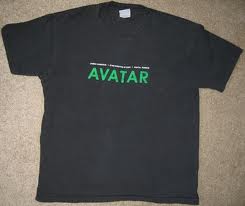
Some of you might remember that at SIGGRAPH ’97, Digital Domain had given out black tee shirts that proudly proclaimed:

James Cameron/Stan Winston Studio/Digital Domain

AVATAR

As a result of financial issues surrounding TITANIC, Cameron had tried to make good to the company he helped found by offering DD a”back end” participation on his next epic. In the late 90’s it was obvious to me, and everyone else that read AVATAR, that the images that Cameron envisioned were practically impossible. Clearly there was a need to do massive amounts of R&D for even a proof of concept, let alone mounting a production.

Twentieth Century Fox was prepared to fund a fairly expensive test. Unfortunately they (Fox) wanted to own the code that DD developed. Being the “smartest guy in the room”, I assumed that the software developed for creating the “Navi” would be worth much more than receiving profit participation in AVATAR. I mean, how much could a movie make?

The rest is, as they say, history.

As a kid, I only got into a fistfight once (my fifth grade classmate, Abe, said my Mom smelled like dogshit… what was I supposed to do?)… but, I never backed down from a fight.  I was little, skinny and quick tongued. I didn’t have much of a left hook but I had one helluva mouth.

I could talk my way out of anything, or so I thought.  I was a 92 pound weakling with two hundred pounds of bullshit and attitude.

Sometime in the early part of the last decade, I was invited to give a presentation in Korea. At the time, I was knee deep in a messy divorce and would do most anything to get as far away as possible, preferably Asia.

And, speaking in front of crowds… well, that was easy for me, so easy that I always just “winged it”.

One morning, I was picked up by my favorite limo driver, Berndt, driven to LAX and boarded a KAL 747 and flew to Seoul. Upon arrival, I was met by several Korean officials and whisked off to the InterContinental COEX, where, still terribly hungover from Ambien and severely jet-lagged, I was shown to my room. I unpacked, took a quick shower and considered my options.  I could call a buddy and go out on the town or I could stay in and try to outline my speech for tomorrow’s presentation.

The choice was obvious.

I arrived back at the InterContinental Hotel at about 3 AM. After countless hours of Karaoke and dozens of shots of Shochu,  I was toast. My internal clock was set to Pacific Standard Time, but the clock in my room read  “3:19”. My speech was in less than 7 hours.  I hadn’t planned my talk. I hadn’t even looked at what the conference was about. What hubris. I scanned the room for the bag that they handed me at reception when I checked in.  You know, those cheap, “wanna be fake computer bags” with the conference logo stenciled on the front flap.  The ones that you will never use again because it says something dumb like, “with our collective vision, we can change the world”…. XYZ Industries, Kyoto 1995.

There it was, lying on the floor, next to the desk. I opened the flap, pulled out the brochure and stared at it for a bit.  After a couple of seconds my eyes finally focused, it said “World Economic Forum, Seoul Korea”. World Economic Forum? Why the hell was I asked to speak at an economic forum?  I scanned the speakers list.  There were dozens of names.  It seemed like every speaker was the chair of some Economics Department at a major university…  Harvard, Stanford, Cambridge, Yale, Oxford and so on. The theme of the conference was how to transform Korea and move it from the 11th largest economy in the world into the top 10.

My degree was in Communications and while I was adept at business, the only thing I knew about Economics was the theory of “supply and demand”.  While at that very moment my body demanded sleep, I needed to write a speech. All my fears of not making the honor roll, failing my Geometry final and every other academic nightmare surfaced.  I was scared to death. When I got on the plane that day, I assumed that if I showed the Digital Domain demo reel, everyone would be so wowed that it really wouldn’t  matter what I said. I spent the next several hours sobering up and writing an outline.

At 8 o’clock I put on a suit and tie ( it was after all, an economic forum with PhD’s and stuff) and headed to the COEX convention center which was connected to the hotel via an underground passageway.  I always liked getting the feel of a room before I spoke and I always wanted to check DVD playback to make sure that the contrast, brightness, hue and saturation levels were correct. That day, I also figured that maybe I could hear the speakers before me and get a better sense of what the conference was about.

I asked the fellow at the information desk where the conference was being held.  He waved me in the direction of a double door, which I opened.

My jaw hit the floor,  my stomach did several flips.  The “room” was gigantic, filled with about 3000 people. There was TV coverage and it was lit to about 150 foot candles… so bright that I wish I had applied SPF 50 .

Before I knew it, my name was being announced. Digital Domain’s demo reel played. It did the trick, after the Powerpoint of the previous speaker, the audience was blown away by the visual effects on APOLLO 13 and TITANIC.  I walked up to the podium, freightened because I couldn’t wing this one, like I did most everything else in my life.

I compared Korea’s economy to THE WIZARD OF OZ  (must have been the Ambien) … something about the yellow brick road and believing that there was a path to the future. I told the audience that believing was the critical part and that there truly is “no place like home”. I went on talking about surfers needing to look to the horizon,  to see the next set of waves, not just the next wave. I spoke about Korea needing to move from a manufacturing culture to a content culture, to stop just making TV’s and to start making TV shows … video games and movies (after all I was always looking for funding for a content play).

I finished my 45 minute presentation and afterwards I was asked bunches of questions by the press.

“Do you like Korean films”?

“Do you like Korean food”?

“Do you think Korean animation and visual effects are good”?

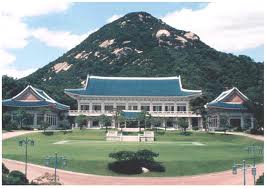
I guess I answered the questions correctly because I was invited to have breakfast the next morning at the “Blue House” (Korea’s version of the White House) by Korea’s then President, Roh Moo-hyun.

The President of the Republic of Korea had invited me to breakfast, damn.

The next morning I was picked up by a black car and driven to the Blue House. With the help of an interpreter, we “chatted” throughout breakfast.

” Is Kim Chong-Il crazy and will he use nuclear weapons ?” , I asked.

“No, he’s not crazy at all, he just wants the world to believe he’s crazy and that he might use nuclear weapons”, the President of Korea answered.   ” He needs money desperately, and if he acts crazy and threatens using Atomic Bombs, someone might pay him not to” Roh, continued.

” That’s what frightens me, if he’s only interested in cash, then some terrorist organization with lots of oil money could buy his nukes”, I said.

” Oh, there’s nothing to fear, Kim Chong-Il will sell them to the highest bidder … and the highest bidder will be the United States”, Roh responded.

I thought to myself… ” I hope “the Dear Leader” fully understands the Eleventh Commandment”.

After all, it took me 60 years to stop believing my own hype.

Dear Leader


· · · ◊ ◊ ◊ · · ·

What, pay retail ?

02 Oct 2011


One of the key issues when partnering with a strategic investor should always be “what makes them so strategic?” One of the key issues when partnering with an individual should be “what value does that person bring and what does that individual want from the partnership”?

All of those issues and more were swimming around my head when I first started Digital Domain. It was pretty easy to get my head around why Jim Cameron was to be my partner, a brilliant filmmaker, a technical wunderkind, a guaranteed revenue stream and as time has proven, a person that knows how to make some serious quan!  IBM, was a different story all together.

The IBM Company at the time was going through some serious issues. Their longtime Chairman John Akers was on his way out and their new Chairman, Lou Gerstner, the former CEO of RJR Nabisco was just getting the big blue bit between his teeth. IBM had made some major mistakes in the years prior to Gerstner’s arrival.  Gerstner’s belief in the internet, his turning the company’s culture around from the staid 1950’s sensibilities and his focus on the IT services business resulted in one of the great turnarounds in the history of corporate America.

That being said, IBM did not have a product offering  that made any sense for a digital film and media company starting in the early 90’s. But they did have some cash. And so when we started talking to some very forward thinking IBM’ers, Kathleen Earley and Lucie Fjeldstad, I made it pretty clear that we would not be willing to commit to purchasing any equipment from IBM.  I was pretty set on purchasing SGI (Silicon Graphics) workstations as SGI was the computer company that I had formed a relationship with whilst I headed up Industrial Light and Magic.

Once we received the cash from IBM, I went on a shopping spree.  I set up a meeting with the SGI brass, Ed McCracken and Tom Jermoluk at their company headquarters in Mountain View CA.  Cameron and I flew up to San Jose.  On the way there, we stopped at NASA Moffet Field, where we were given a tour of the new CGI simulation lab.  The NASA guys were very proud of their simulation of the Mars Rover being driven around the surface of Mars.

I was shocked.  I mean here we were at NASA, the cutting edge space agency of the most powerful and technologically advanced nation on the planet and the stuff they were doing looked like a bad video game! I then realized that there were a lot more resources available to folks making movies about spacetravel than folks trying to land actual spaceships on distant worlds.

We arrived at SGI headquarters where Jim and I were shuffled off to one of their two conference rooms.  We were not offered coffee or water by some office babe, after all this was Silicon Valley not LA. The receptionist offered us a choice of rooms, either the TERMINATOR 2 conference room or the ABYSS conference room.  I saw the glint in Cameron’s eyes when he chose the ABYSS room, I guess he always felt more comfortable in water.

After a few minutes, Jermoluk and a few others joined us and explained that McCracken, SGI’s CEO was unavailable as he was involved in some political fundraiser.  It turned out that McCracken had turned his attention to being very active in national politics and not very active in the running of SGI. McCracken seemed to care much more about being popular than being profitable.  He hosted lavish parties, was on the cover of magazines and seemed to know Al Gore and Bill Clinton on a first name basis. I always thought (given my rather large ego) that SGI became the Hollywood household name because of my inviting them to the table with ILM back in 1990. In fact, much of SGI’s marketing patina was based upon its relation to Hollywood and ILM.  And now here we were, sitting in the ABYSS conference room with Jim Cameron, the director of the ABYSS and me, the fellow that started SGI’s romance with the movie industry.

SGI dudes wore a specific uniform of the day… the Silicon Valley drag of the 90’s… khaki trousers, replete with pleats ( who ever came up with the idea that pants that made you look fat were cool, I have no idea), a Polo shirt emblazoned with the Company logo and a pair of penny loafers. And so here we were, surrounded by SGI studs in corporate drag.  Jermoluk immediately started to press the flesh and tell us about how excited he and his SGI drones were to “hang” with us.  I explained the origins of Digital Domain, who our partners were (IBM) and that I was here to forge yet another meaningful relationship with SGI.  DD was ready to outfit its facility with SGI boxes and their famous refrigerator  multi core machines.  DD already had a few SGI Onyx’s and Challenge’s that were shipped over from Stan Winston Studio ( which we paid Stan handsomely for). And given my existing relationship with SGI, and Jim’s celebrity, we were looking for a deep discount as well as a special strategic relationship with SGI.

Jermoluk took the floor and explained to us that SGI was in the process of formalizing a strategic partnership with LucasFilm and given that DD was funded by IBM, the discount structure would be considerably less than I had hoped for.  In addition, Jermoluk went on to say that since IBM was a direct competitor ( which at this point, it was most definitely not, for had it been, I would have bought IBM hardware), SGI would not enter into any special relationship with DD.  A few months later SGI and Lucasfilm announced the JEDI Collaboration.

Needless to say, I left Mountainview rather upset. There was no other choice for hardware, and as I had set my sights on competing directly with ILM, we needed to have at least, a similar cost basis for our work. If DD did not acquire SGI machines at the same sweetheart deal as ILM, our cost basis for our bids to our clients would not be competitive. A solution was critical. I was pissed.

The expense for hardware, back in the day, was considerably higher than the expense for software but software was still a critical component in pricing. At the time, ILM had been using Alias/Wavefront and Renderman as its basic pipeline, and just as I had negotiated ILM’s SGI deal, I had also built a strong relationship with Alias’s then CEO, Rob Burgess.

DD needed to get up and running quickly, we had a Tim Burton logo to do ( Buried Alive) and Jim was counting on us for the visual effects on his next film, TRUE LIES. So, time was of the essence. While I was knee deep in hammering out our Alias deal and I was expressing my SGI discontent with Burgess, Rob came up with a brilliant solution. It seemed that Alias had what was known as a VAR (Value Added Reseller) agreement with SGI and this agreement allowed Alias to buy and resell SGI equipment as long as it was bundled with Alias software. And it seemed that Alias’ VAR pricing with SGI was lower than any discount I had negotiated with SGI whilst at Lucasfilm. The hitch was that I needed to buy more Alias software than DD needed. Eventually, through the good graces of Mr. Burgess and The Alias software company, DD bought its SGI machines for less than ILM/LucasFilm were able to purchase theirs for and DD bought exactly the right amount of Alias licenses at a very deep discount as well.

DD’s IBM board, though not thrilled with my decision to purchase millions of dollars of SGI computers, did stand by their word and “understood” that the IBM company was just not in the visual computing game and that they offered no hardware solutions whatsoever.  A few months later, and a few DD/IBM board seat changes, DD now had IBM’s chief technologist on its board. Very shortly thereafter, DD had been introduced to IBM’s Power Visualization Sytems (PVS) a $350,000 super computer that had an unbelievable I/O and allowed DD incredible flexibility in the early days.  Unfortunately there were, to my understanding, only 2 machines built and no spare parts. After about a year of depending on the PVS, and that no one else bought a PVS ( ours was lent to DD for testing), IBM decided to abandon the PVS and DD’s machine was hauled away and crushed.

Sometime in 1996 or so, I read an article in Wired Magazine written by the founder of Pacific Data Images ( later to become Dreamworks Animation), Carl Rosendahl.  By this time everyone doing visual effects and CG animation were pretty much fed up with SGI.  We used to have a saying about SGI and their utter arrogance …. “we are SGI, we don’t care because we don’t have to”.  SGI was overpriced and took their eye of the ball.  Carl’s article in Wired changed the way I viewed hardware suppliers.  Carl made a statement that Intel architecture companies were spending more money in one year on researching visual computing than SGI’s total revenue for that same year.  At last, there was an alternative.  Within a year or so, DD had transitioned away from SGI and was now only buying Intel based machines…. at a fraction of the cost. Just eight years later SGI was delisted from the New York stock exchange and in 2009, SGI filed for Chapter 11 bankruptcy.


· · · ◊ ◊ ◊ · · ·

Agents of Change?

27 Jul 2011

There is that age old adage in the film business, “How do you know when an agent is lying? When his lips are moving”.

Just a year after Digital Domain was founded, I started to get some interesting inquiries about the company and my future. DD had entered the film industry with a bang. In our first year we were nominated for an Oscar for best visual effects (TRUE LIES); a Cannes Gold Lion Award (Jeep); an MTV Music Video of the Year Award (The Rolling Stones, LOVE IS STRONG); several Clios and we were considered by many to be the baddest VFX company around.

I had set out to make sure that we were the antithesis of corporate Sony Pictures Imageworks (SPI) and much looser and cooler than Industrial Light and Magic (ILM). We had kick ass parties, brandished tattoos and flew a pirate flag over our headquarters in Venice CA. That bad ass image and the fact that we were doing some really breakthrough and incredible work, helped build a culture of comraderie and panache. To this day, eighteen years later, there are weekly Friday evening dinner parties thrown at a local Venice restaurant where dozens of ex DD employees show up to hang out with their pals from over a decade ago.

Digital Domain is still considered to be one of the big five VFX companies in the world, but back in the day it was the Led Zep to ILM’s Beatles. We were a rag tag bunch of Pirates that just happened to win Academy Awards.

The company was sold back in 2006 and I’ve heard that things are different there now. New management from ILM has taken over and changed the culture significantly but I still get a thrill when I drive by the Venice HQ and recall one of DD’s employees saying that I built the only Rock n Roll VFX company in the world.

I had tee shirts printed in 1994 that had the DD logo and the phrase “Start Up” on the front, but on the back it said “Upstart”. And that’s what we were…

In 1995, I received a phone call from the then CAA’s Sandy Climan to inquire whether I might be interested in having an informal lunch with he and his boss, super agent and founder of Creative Artists Agency, Michael Ovitz. At the time, Mr Ovitz was arguably the most powerful person in the entertainment business. CAA is often cited as the world’s leading talent agency and its clients include George Clooney, Meryl Streep, Brad Pitt, Lebron James, Sandra Bullock, Oprah Winfrey, Julia Roberts, Steven Spielberg, Will Smith, and Reese Witherspoon.

Climan said that Ovitz was involved in a really big deal that he wanted to talk to me about. I couldn’t imagine that Ovitz knew who I was, let alone wanting to have a meeting with me. I ran a VFX company, yes we were cool, but by geek standards only, not A list Hollywood movie star standards. Climan went on, explaining that Ovitz would like to meet with the principals of DD but mostly he was interested in spending some time with me.

My head slowly started to expand.

The date was set. Cameron could make it but Winston could not. I called Climan back, left a message and explained the situation. Climan returned my call and left a message, “Cameron and you would be fine”. I called Sandy and confirmed, leaving yet another message.

Jim picked me up at DD in his Calloway, a twin turbo sledgehammer of a Corvette. In a very short period of time, we pulled up in front of CAA’s I.M. Pei designed headquarters in Beverly Hills. The valet grabbed the keys and smiled that knowing look. The one that said, “I’m taking your $250,000 American car for a joy ride”.

This, clearly, was a different scene then Venice. Men wore suits ( albeit $5000 ones with strange designs from Italy and Japan), women wore fashion and it all seemed like it was a photo shoot for Vanity Fair. I was a Venice duck out of water. I smoothed my tee shirt and entered the marble and glass palace of the king of deals.

We were immediately met by two stunningly beautiful women, suited up in the hippest fashion. We followed them into an elevator, that seemed to be only for us, and went upstairs to meet with Michael Ovitz.

The elevator doors slowly opened, revealing Sandy Climan’s smiling face and outstretched hand. In an instant the women had disappeared only to return seconds later with beverages and the ubiquitous LA greeting ” Would you like something to drink ?” I personally believe we could put a major dent in water shortages around the world if people in the entertainment business did not accept the mandatory bottled water upon the start of every meeting.
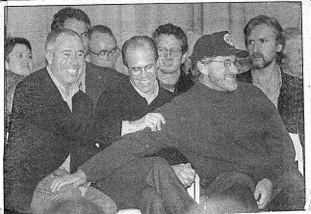
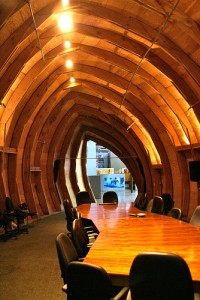

Sandy explained that Michael was running a bit late, “but please, help yourself to the Sushi” that had been prepared for us. Sandy did not give us any more info than he did on the phone several days earlier. It was as if he wanted Ovitz to deliver the news. After about fifteen minutes, Ovitz entered the room and headed directly to me. He gushed for several minutes about how he had been following my career since LucasFilm and that it was such a pleasure to meet me. At this point I was starting to blush, I glanced over at Cameron who is standing alone without any of the adulation he usually receives.

Finally, we sit down and the “meeting” begins. Ovitz says that he can’t really tell us the whole story as we are not under NDA ( Non Disclosure Agreements) but that he has been asked by the Baby Bells ( the regional bell operating companies after the ATT divestiture) to help put together a new digital distribution entity. Sort of the new version of a major motion picture studio. And, he has chosen the guy to run it… me.

“Ok, okay, ok…. get a hold of yourself, Scott”, I say to myself, “you’re some Jewish, Bayside, blue collar, ex messenger boy, drug runner, wanna be soul singer and the most powerful man in show biz just offered you a job to start and head up the new iteration of Warner Brothers”. I sat up like there was a rod up my ass and the rod was pumping pure ecstacy throughout my body.
Everything in the room took on a purple glow, I turned to Cameron with a shit eating grin on my face and said “Jim, let’s go”.

As we started to leave, Ovitz stopped us and said, “There are a few things we have to take care of first. We’ll need the signed NDA’s and one more thing… Jim, you can’t have Jeff Berg as your agent.” Jeff Berg was the head of ICM, International Creative Management, Cameron’s long time agent. Ovitz went on “… Berg is a fake, he takes everything I do and copies it, I just can’t be in business with someone that has Jeff Berg as an agent”.

We got into the Callaway, Jim flipped the valet safe switch ( the one that only allows partial turbo power, making sure that the Valet couldn’t red line it), put the keys in the ignition and said ” Funny, but I fired Jeff yesterday, it will be all over the trades tomorrow”. The engine fired and my head slammed back against the seat and we were off.

At about the same time, I received a call from Jeffrey Katzenberg’s office. Mr. Katzenberg wanted to have a meeting with me. Katzenberg’s assistant wanted to schedule a 7 o’clock meeting during the week. I asked my assistant if we might be able to move it up by say an hour or so because I wanted to get home by a reasonable hour. Both assistants worked their magic and compromised a bit. The time had been agreed upon, 6:30. Looked like I might be home by 8 PM or so, a typical night.

A few weeks passed and the Katzenberg meeting was on for the next day. At close of business that day, my assistant handed me my end of day “to do’s list” and reminded me of the meeting set with Jeffrey Katzenberg for tomorrow.

Got it.

She said ” you should probably leave your house at about 5 AM just to be sure”.

“WHAT?… 5 AM? What?”, I stammered.

“Yes, Jeffrey gets in very early and wants to meet with you first thing”, she said.

I drove to the old Amblin offices on the Universal lot. Nothing much had seemingly changed at the Amblin compound since the announcement of this new studio, Dreamworks SKG. Katzenberg had relocated from Disney and David Geffen seemed not to be there. I arrived not so bright and stupidly early. There was once again, the perfunctory, “Can I get you something to drink?” from someone. I was met by Jeffrey and escorted down the hall. We met several people on the way to the outdoor breakfast area… Mo Ostin, the legendary WB record exec was there to greet me as well.

Breakfast with Jeffrey was interesting. He spoke about the hollowness of legacy, his recent run in with a male lion and eventually we got around to why he asked me to come by. He offered me a job to run DreamWorks Interactive. Duly flattered, I turned him down. I had an employment contract and had started DD just a few years before. I was looking to build DD into a great company, a content producer and a media powerhouse.

He asked me what it was I wanted to do with my life. I told him that after my mother had passed, I realized that her “essence” lived on inside of me but that after a generation or so, her life impact would be lost. I didn’t want that to happen to my life. I told him that I needn’t be famous, that people don’t need to know my name… but, that my time here on this planet needed to make a difference for generations to come. That my life indeed contributed to our collective consciousness.

Katzenberg stopped and looked deeply into my soul… I felt him. He said, … legacy is an awful burden, look at Disney.” He went on, ” Last night, I saw an amazing film that summed it up rather well, it was when Captain Picard and Captain Kirk talked about whether they made a difference”. “You see, it’s the journey, not the destination”.

kirk picard

Heavy.

I was hoping for Camus or Sartre but i got STAR TREK : GENERATIONS.
I passed on the gig but recommended EA’s Glenn Entis, who got the job.

When, Ovitz had heard the news that Cameron had fired ICM and Berg, my phone rang. Several messages back and forth and finally a second meeting was had. In my mind I had already spent my “signing bonus”, had picked out a name for my Gulfstream and saw myself as the new CEO of this new Baby Bell venture. I was rockin’!

This Ovitz meeting was more of the same. My ego was stroked so hard, it began to chaff. Michael told us a bit more. Michael suggested that maybe we fold DD into the new venture, and that our facility could act as the content creation engine for this new digital distribution channel. Michael ended the meeting.

Then Ovitz turned to Cameron and said ” I’m glad to see you got rid of Berg”.

Jim said ” yeah, I don’t really need an agent”.

Ovitz frowned and said, “Jim… everyone needs an agent”.

Jim said, “I don’t”.

Ovitz got red in the face. “Yes you do Jim”.

Cameron started towards the door. ” No, Mike, I don’t”.

“Spielberg needs an agent, Lucas needs an agent… everyone needs an agent Jim”, Ovitz was agitated.

“Not”, said Cameron.

We walked out of his office, took the elevator to the lobby and walked out the front door.

I never heard from, nor saw Michael Ovitz again.

· · · ◊ ◊ ◊ · · ·

The Whale

Juggling the IBM board members as well as the Operating Committee at DD was no easy task. The original IBM board members were Lee Dayton (Vice President, Corporate Development and Real Estate of IBM), Kathleen Earley (Director of IBM’s Multimedia Alliances/High Performance Computing division) and Jim Cannavino (Chief Executive Officer of IBM). The original DD board members and its Operating Committee was comprised of James Cameron, Stan Winston and yours truly .

At DD’s founding I was the CEO and President, but Jim, in deference to his stature in the entertainment industry, was named Chairman of the Board. The Company was structured in an interesting way. The Founders (Jim, Stan and Scott … with some serious input by Ms. Sanchini) were concerned that the new company should be managed and operated by people that understood the entertainment business. IBM, which was the sole financial investor felt that DD should have some serious oversight, at least financially, by IBM. To those ends, I hired Chris McKibbin, a 20 something IBM wunderkind that previously wore suits and blue ties but once he moved to DD in LA, dressed in jeans and tees and quickly adapted to the “lifestyle”.

The Operating Committee idea was unique to me. It had most of the powers of the board, answered to the board, would come to a decision by a 2 vote majority ( the 3rd dissenting voter was overruled and the resulting decision became unanimous if needed to go to the actual board for approval). This committee was to meet often, maybe 2 times a month. While the day to day executive oversight was left to me, I had to answer to this committee on serious issues.

Interestingly enough, given the schedules and responsibilities of the other two Operating Committee members, we rarely met. And when we did meet, a significant portion of the “meetings” were spent talking about the latest in Hollywood… what good films were playing and why etc., and IMHO, we rarely ever got to the business at hand. Oftentimes these meetings would be rescheduled, rearranged and then finally cancelled. Needless to say, it became frustrating. Additionally, when we did have meetings and issues were addressed, it only took 2 votes to pass.

Jim and Stan go way back, they were dear close friends (at least it seemed so to me, but this was Hollywood after all), and Stan really got his big break on TERMINATOR and owed Jim a lot.

Oftentimes I was the dissenting vote. Yet when we got back to the board, I delivered the message that the Operating Committee wanted delivered. As I reported to the Operating Committee, the Operating Committee had the power to determine the executive structure of the Company. For example, at about the same time TITANIC was supposed to be in its final stages of delivery (TITANIC was to be a Summer release, July 2 1997, and was not going to meet its date as the VFX could not be completed on time because JC was not finished shooting plates), the Operating Committee decided that I should no longer be the CEO of the company but rather, as Jim put it ” I will be the “C”, Stan will be the “E” and you (Scott) will be the “O”. And then he went on ” and we need to hire a new President that will run the company on a day to day basis… that person will report to the Operating Committee”.

The vote was, of course, 2 to 1 to hire a new President. I then went on an international search, by the behest of JIM/stan . I interviewed about a half dozen candidates. But more on that later.

The IBM board members had gone through several changes as IBM tried to figure out just what benefit Digital Domain was to “Big Blue”. Additionally, I don’t think IBM had much experience with entertainment industry folk. For example, after a rather large press conference announcing the joint venture, an initial board meeting was set. Everyone had great expectations.

The date of our initial board meeting arrived. At this point DD already was ensconsed in the Chiat/Day headquarters in Venice CA. Jay Chiat, the Chairman of the famed Chiat/Day advertising agency ( Apple Mac Big Brother 1984 as well as hundreds of award winning creative awards for TV Commercials) and I struck a deal. C/D would move out of their 120,000 sq ft facility over a period of several months and as DD grew, we would take the new space. Needless to say, one of the most creative and successful Ad Agencies had some pretty spectacular interior design elements, albeit in the cavernous interior of an old Levolor Blind factory.

The famous architect Frank Gehry, had been a friend of Chiat’s and Gehry was called upon to design C/D’s new building (now occupied by Google) just across the street from their (now DD’s) vast warehouse space. I assumed as part of the deal, that Frank Gehry had also designed some pretty fabulous structures and interiors in the Warehouse. Some of these included the famous “Whale” conference room as well as specially designed cubicles made of very expensive multi laminated wood. Another C/D conference room was a cardboard box built inside of the actual structure where multiple cardboard chairs and loungers gathered around a surfboard light fixture hung from the ceiling as Lee Clow, C/D’s Chief Creative Officer (currently the Chairman and Global Director of TBWA\Worldwide. Advertising Age referred to him as “advertising’s art director guru”) was/is an avid surfer.

Well, when DD moved in, things needed to change. The Whale conference room remained, but Jay Chiat wanted his 40 foot conference table back, or a princely sum of about $50,000 for us to buy it. It, like most of the interior was designed by Gehry. Additionally, I needed to get rid of the second “Surfer Cardboard” conference room and equip it as a screening room.

I grew up in the South Bronx and Queens and my concept of art, which was hammered into my head in the fourth grade by my teacher, Mrs. Lawrence, was primarily centered around impressionist paintings of the late nineteenth century, French, mais oui. At the time, I had no idea who Frank Gehry was.

I proceeded to tell my group of carpenters and stage guys ( yes, there used to be the need for these skills at a VFX studio) to use the laminated cubicles to build apple boxes, to dismantle the Surfer Cardboard room and throw out all those corrugated cardboard chairs ( I mean, who wants to sit on cardboard?)

Cardboard Chairs

Cardboard Chairs

They were instructed to copy the 40 foot conference table and send the original back to Jay. At that moment, I believe I single handedly ordered the destruction of priceless art (?) yet, I did get a $50k conference table for about $5k. And, DD might have the most exclusive compliment of Frank Gehry apple boxes in the world.

Well, the day of DD’s first board meeting had arrived. This inaugural meeting had been carefully planned by my assistant, Joanna Capitano. The IBM jet was due to arrive at Santa Monica airport sometime around noon. The 4 special parking spots were cleared for Mssrs. Winston and Cameron’s two HumVee’s (they were so huge they needed 2 spots a piece). A van was scheduled to pick up our IBM board members and I was, nervous.

At about 10AM or so, Joanna got a phone call from Lisa Dennis, Cameron’s assistant, explaining that Jim was unable to make it to the board meeting, that something had come up. I freaked. The Citation was somewhere over Colorado at this point and I had no way of informing the IBM’ers that Jim and now Stan, would be unable to join us.

I met the jet at Santa Monica Airport, shook a few hands, and explained that items on today’s agenda might have to change. After informing the group that there would be no Board meeting, I toured them around the new facilities, explaining our choice of SGI computers over IBM mainframes, and then we sat down to a wonderful lunch, gathered around a $5000 Frank Gehry “inspired” conference table.

· · · ◊ ◊ ◊ · · ·

A Pirates Life For Me

14 Jul 2011

It had been nine months since I left LucasFilm. I had just turned 41. I had a 12 year old, a 6 year old and a 2 year old, as well as a wife that hadn’t worked in years, and I was close to running out of money. IBM had agreed to fund the new company and we were almost at closing. I could see the finish line. I didn’t realize we had only just begun.

We signed all documents in the opening weeks of the new year, 1993. The decision had been made several months ago (especially after the ILM braintrust had decided not to be involved), that DD would be located in LA, “where movies were made”, as my partners said…. not in the Bay Area where there was only George and Francis Coppola. My then wife decided that our family would not move to LA until the end of the school year. But I needed to be in LA asap, so I found a small place in Santa Monica and commuted for almost six months, flying backwards on Southwest Airlines every Monday morning and returning to Marin every Friday evening.

Cameron was nice enough to let me use a small office in Lightstorm’s three story office building. Every morning I would rise at about 6 AM, drink my coffee and head over to the office. I needed to find a location, start to hire staff, make decisions about and negotiate capital equipment purchases, figure out power needs, technical infrastructure, set up business affairs and thousands of other details needed to start a major digital VFX studio. Of course I had help…. Diane (my assistant from ILM) was invaluable and literally drove me like a dog. Her 14 year old daughter moved into my house in Marin and she moved in with me in Santa Monica. You can imagine the rumors. Diane was a great friend, a task master, an organizing machine, but that’s where the relationship ended. Interestingly enough that is not what several staff members thought.

I had hired an overweight African American woman to be DD’s Director of Human Resources. She came highly qualified, I think she worked for LA Metro beforehand. I guess the rumor mill had started that Diane and I were more than just living together.

In the beginning months of DD’s start up, Diane was focused and on point and didn’t suffer fools gladly. Some people started to complain about her “bedside manner” (not that I knew anything about that). Of course they went directly to the HR person. After a few complaints, this HR women allegedly said to one of our VP’s ” That must be some fine (expletive deleted) for Scott Ross to put up with that kinda shit!” This certain VP came and told me what she said and I headed to her office to check it out. Once our HR Director saw me, she squeezed herself out of her chair and started packing her office and was gone in 15 minutes. I never really had to say a word. She knew what she did, and she was gone, gone gone.

Every morning showing up at Lightstorm was a bit strange. There were rarely any people there. Albeit, I did arrive early. Generally it was me and the office manager and sometimes a tech or two. My office was down the hall from Cameron’s. Mine was a loaner office, about 6 feet x 8 feet. Jim’s office on the other hand took up about half the entire floor, it was awesome. Complete with a living room with couches, a big screen TV, a fully equipped kitchen, an office area with a huge desk and a conference table. The furnishings were expensive and ecclectic, replete with a samurai sword and the articulated arm and hand of a Terminator T 800 that Stan Winston had given Jim as a present. The T 800 armature stood on the corner of Camerons’ 10 foot or so desk.

Cameron’s office door was never locked, yet this was the dude that a few years before, sent an assistant with the T2 script locked in a briefcase to allow me and a few other ILM’ers the chance to read it.

At Lightstorm however, I could walk into Cameron’s office and hang out there by myself without anyone knowing. Every once in awhile the early warning system would go off and the Lightstorm team would scramble…. “JIM IS 15 MINUTES OUT!!!!”, the office manager would shout. Battle Stations, Battle Stations, defcon 5… vacuum the carpets, sweep the floors, stock the kitchen with tuna fish and peas, make sure the bathrooms are spotless.

During these drills, I would, at times, sneak into JC’s office and, well, organize the fingers on the T800 armature in such a way, that the middle intiger stood proudly at attention while the other digits were clenched in a fist. Childish, I know, but somehow oddly comforting. I am after all a prankster.

At this point, we needed our own space as DD started to collect personnel. Along with the IBM investment came three IBM board members and three IBM team members. It seemed that IBM techies, Brian and Joe wrote the plan that IBM was considering when they first thought about a digital studio. They joined up. And I felt that IBM would feel much more comfortable if I was to hire a CFO that wore IBM blue. A young twenty-something Chris McKibbin fit the bill nicely. I also needed an Exec Producer for Features and one for Commercials as I was going to organize DD in the same way I had organized ILM. At first two separate product offerings, feature film effects and expensive hi end commercials. Once we got these two running, we would add other products like video games, new media and ultimately feature production. That being the ultimate goal… producing our own content and moving away from the services for hire business.

But while the fledgling DD was still housed in Cameron’s office building and after the early warning system was sounded, I would as I said, “arrange” the T800 . Jim would walk in and see the T800’s clenched fist with outstanding middle finger and demand to know who did this. I never “fessed up”…Call it childish and petty, which it mos def was…. but for some strange reason, it made not being with my family a little bit more palatable.

· · · ◊ ◊ ◊ · · ·

Clockwise: Stan Winston, Scott Ross, James Cameron, Kathleen Earley (IBM)

With Jim and Stan in place as partners, it seemed that it might be easier to secure financing for our new company. I was tasked with finding the investor or investors. Jim Cameron wasn’t the household name he is today, but even in 1992 he was, as far as directors go, pretty much a star. He wasn’t yet the self proclaimed “king of the world” of TITANIC proportions but he was at least a duke, or maybe even a prince. With films like TERMINATOR, ALIENS, THE ABYSS and TERMINATOR 2, he was an ascendant to the throne. Additionally, two of his films won Oscars for Best Visual Effects. He did have a bit of a reputation, but his films won Oscars, and a few made some big money. All in all, while the vision for DD was mine, Jim was the bait.

Armed with bait, I started to chum. There was the ill fated Electronic Arts effort but there were also others… Intel, Sun Microsystems, Microsoft, Carlton Communications, Phillips, Virgin, Nintendo, SEGA, SGI, Viacom, Turner, TCI, Comcast, the Baby Bells, Autodesk, NTT, AT&T, Apple, Next and so on. You get the picture. There were hundreds of phone calls, letters and airplane trips. The meetings and discussions of 20 years ago seem like a blur today, but one stands out for several reasons.

The first reason was that Jim and Stan were actually in attendance that evening, a rare occurrence. It was a dinner meeting at the Ivy at the Shore. Our dinner was with the then President and COO of Motorola, Chris Galvin ( whose papa was Chairman of Motorola and whose grandpa was Motorola’s founder). I was prepared for a rather stodgy old dude…but it turned out that Chris was just a year older than me, and was very loose and personable. Interestingly enough, at the time of this meeting, there was a lot of hoopla about the possibility of cell phone radiation causing brain cancer. Being the 60’s counter culture person that I am, I decided to, unbeknownst to Jim and Stan, pull a little prank. At this point, I had been turned down by dozens of folks and I started to get a little cynical about this whole entrepreneurial crap. As dinner progressed, I was getting the vibe that Mr. Galvin was much more interested in talking about his new global satellite cell phone coverage scheme (Iridium) and much less interested in being a part of DD. When dessert finally came, I pulled a wad of aluminum foil from my briefcase, fashioned it into a helmet, pulled out my Motorola Star Tac cell phone and started dialing. I turned to Chris and said ” One can never be too safe”. Stan waved at our waiter and yelled ” Check!”

Some have said that Digital Domain was the brainchild of Jim Cameron and that he and his partner, Stan Winston birthed DD ( in fact, Jim Cameron seems to say this often). There is no doubt about the fact that Jim was instrumental in the company, attracting investment and artists. There is no question that Mr. Cameron gave the company instant credibility because of his stature or that Mr. Cameron gave DD its first big project, TRUE LIES ( which was nominated for an Academy Award for Best Visual Effects, AND was severely discounted). Jim Cameron was an important component in the launching of DD. But one of the most important things that Jim did for DD was to allow me the use of the incredible mind of Rae Sanchini.

Rae Sanchini was a force of nature, one of the most gifted and strategic attorneys I’ve ever met. I first met Sanchini at Carolco Pictures. Rae was the head of business affairs. I had spoken to Rae’s assistant, Kim, a number of times and she had arranged for me to meet her boss just after Cameron had shown interest in joining me and my ILM cronies in forming this new VFX company. Cameron and Carolco, headed up by Andy Vajna and Mario Kassar, had in movie speak, “a deep and meaningful relationship” (TERMINATOR 2… i.e. they made lots of money) and I guess Cameron had tried to convince Andy and Mario that Carolco should fund DD.

I flew to Burbank, rented a car and drove to Carolco’s offices on Sunset just across from Tower Records. I took the elevator up to the top floor of this swanky Sunset Strip building. I was very impressed by the digs…. my ILM strip mall office palled in comparison. The elevator doors opened, I walked to the receptionists desk and there to greet me was a 30 something, stunningly beautiful blond women attired in a black skin tight skirt with a white semi see through business blouse… wow!

I was not in NorCal anymore!

She went to shake my hand and I said ” You must be Kim, I’m here to see Rae Sanchini”. And she said, ” I’m Rae Sanchini”. Up until then I thought I was going to meet Ray Sanchini… and in my mind my Ray was about 60, an Italian American from NYC, about 30 pounds overweight, that went to CCNY and talked like Jimmy Hoffa. Was I ever wrong!

Rae was exactly what I needed to further the founding of DD. A UCLA trained attorney that had been the head of business affairs of a mini major and had the ear of Jim Cameron! As an employee of Carolco, I understood her involvement since Mario and Andy were possibly interested in funding DD. But after Carolco had decided that given their financial constraints, they were not interested, I was a bit confused (yet overjoyed) why Rae was still involved. I was finally set straight. Rae had left Carolco and made a deal with Lightstorm. She would help me with DD legal issues and then she would be involved as a Producer on upcoming Cameron projects. So in effect, Cameron was lending out Sanchini to help DD ( as an aside, she was not being compensated beyond the promise of Jim attaching her as a Producer on his films) with our legal issues.

And help she did! She was organized, smart and strategic. At times she would get frustrated as Stan and Jim were rarely available and were slow in making decisions. Legally, Jim, Stan and I were known as the Founders but Rae would always refer to them as the “Flounders”.

A year or so before I decided to start DD, IBM had pulled together a group of about 10 Hollywood Industry “thought leaders” to discuss the application of story telling and creativity to this new fangled thing called the internet. For some reason, not only did they think I was a “thought leader” but they continued to contact me to see if I might be interested in heading up a “laboratory studio” in Armonk NY.

Hah! Armonk! IBM! Big Blue!

Counter culture ex hippy, Woodstock Nation Scott Ross ? …. Never!

Up against the wall! Power to the People!

A year later and after a multitude of turn downs, I agreed to visit Armonk. After all I was already in NYC giving a speech at Lincoln Center. IBM sent a car to pick me up. I almost didn’t get in… I had the Jefferson Airplane’s “Volunteers of America” playing in my head and walked away from that black sedan three or four times. Finally, I was freezing standing there in the cold NY November air…

I got in.

The drive to Armonk took forever. I was born and raised in NYC but I had lived in California for 20 years. Yet somehow the parkways, littered with orange, red and yellow leaves, the gray sky and the black trunks of the maple and oak trees comforted me. Grace Slick and Marty Balin faded away as I was found myself seated opposite the smiling faces of Lucie Fjeldstad and Kathleen Earley, IBM Vice Presidents. We talked for a few hours and it seemed that they were very interested in funding a digital production studio… in Los Angeles.

We had a funder. I informed Jim and Stan. Now we had to negotiate the damn thing. Jim told Rae to do what she does best, Stan wondered if he could finally deliver his SGI’s and move some of his “CGI staff” over to DD payroll and Rae and I started the long and arduous process of negotiating a deal with one of the biggest corporate giants on the planet.

After about two months of “negotiations”, the countless crossing of T’s and dotting of I’s, the unbelievable minutia that concern lawyers, we had a document that everyone seemed to be happy with. A final meeting with IBM’s law firm Cravath, Swaine and Moore was set to take place in NYC at the firms headquarters. Cravath is the second oldest law firm in the country, founded in 1819 and consistently ranks first among the world’s most prestigious law firms. The meeting took place at the Worldwide Plaza, on 50th Street and Eighth Avenue in Cravath’s glass enclosed conference room on the one millionth floor overlooking all of NY…

I could see for miles and miles and miles and miles, oh yeah!

I Can See For Miles

I’d never seen so many white male WASPS wearing blue suits with white shirts in my life (I’m from the South Bronx). Rae and I were ushered into this aquarium situated in the clouds. The two of us sat down at the conference table which could have comfortably seated 50. On one side was about 15 Cravath dudes, all white and pasty…. and on the other side, an ex-hippy in jeans (wearing real shoes) and a 105 pound blonde bombshell. The Cravath guys sorta smirked when they saw the two of us. They must have figured ” we can kick this hippy and dumb blondes butt”.

Well, I was a push over, intimidated by all that Goyishe power. But Rae, on the other hand, sharpened her gaze, sat down, rolled up her sleeves and blew them away. She knew every part of the agreement and had answers for every question they had. The Opposition on the other hand, were ill prepared and because they were so segmented into various disciplines ( IP, corporate, tax, estate, etc.) , the right hand didn’t know what the left hand was doing.

And so, we walked out later that day, victorious. Grace and Marty Balin’s voice slowly came back into my head…

Hey now it’s time for you and me
Got a revolution got to revolution
Come on now we’re marching to the sea
got a revolution got to revolution !

We are Volunteers of America, Volunteers of America!

Gotta Revolution

Rock on! The Digital Revolution was underway…

· · · ◊ ◊ ◊ · · ·